Predict Peak VRAM Before Downloading a Model (Weights + KV Cache + Quantization)
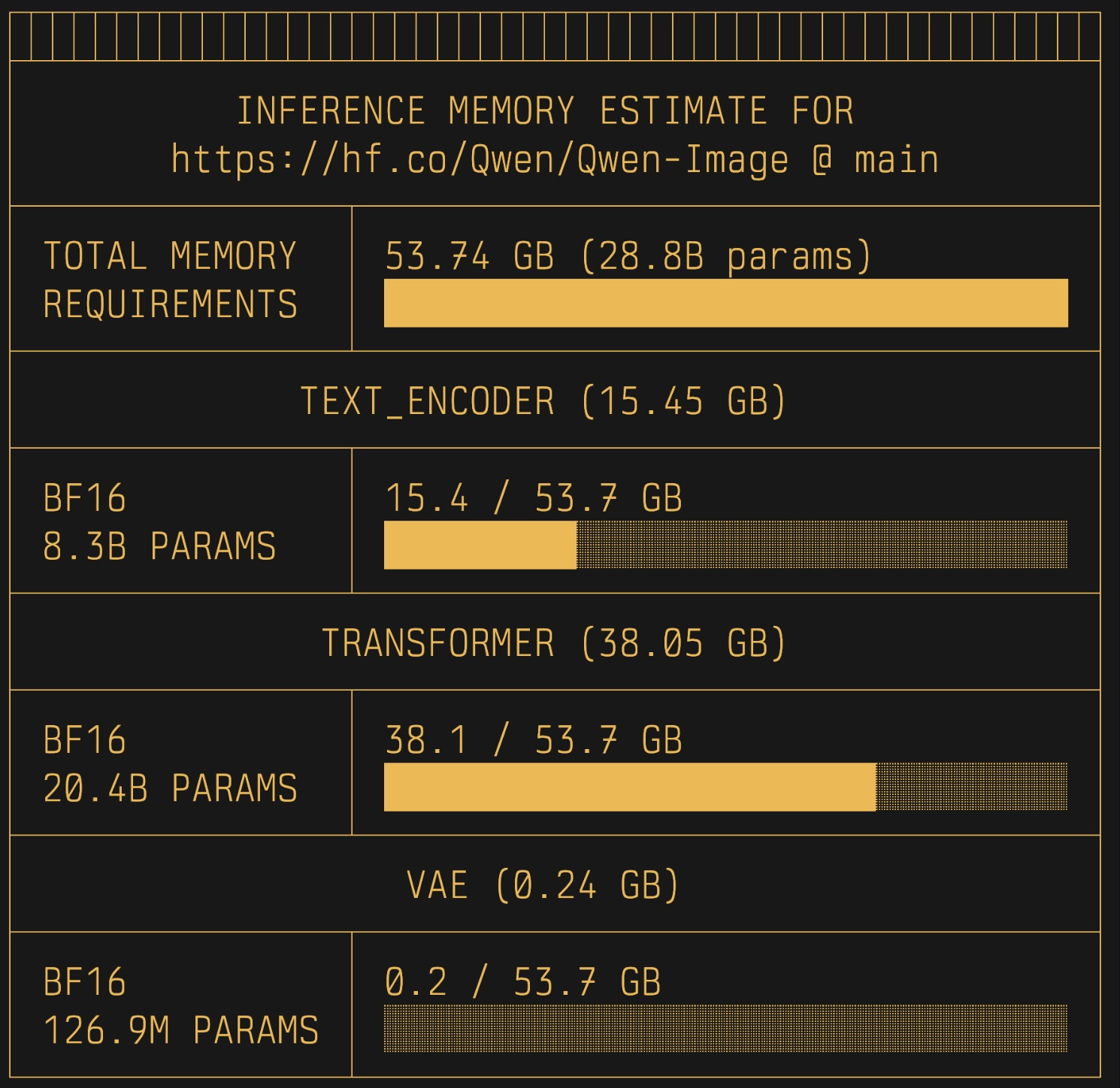
OOM debugging is a waste of time.
If a model is on the Hugging Face Hub in Safetensors, you can estimate most of the VRAM it will need before downloading weights — by reading only the metadata header (shapes + dtypes). The remaining part (activations, temp buffers, allocator behavior) is not perfectly deterministic, but we can still get a practical peak VRAM estimate good enough for capacity planning.
Bottom Line First
Peak inference VRAM is usually:
\[\mathrm{Peak\ VRAM} \approx \mathrm{Weights} + \mathrm{KV\ cache} + \mathrm{Overhead}\]- Weights: deterministic from Safetensors metadata (no tensor download needed)
- KV cache: deterministic from
config.json+ yourbatch_size+context_len+ dtype - Overhead: backend-dependent (FlashAttention/workspaces/allocator). Use a practical margin.
Hugging Face Accelerate explicitly states their estimator is for loading only, and that inference can add up to ~20% extra in practice. That’s a good default margin when you don’t know your runtime yet.
Confidence Levels
| Component | Confidence | Why |
|---|---|---|
| Weights from Safetensors metadata | 99% | Exact byte size from shapes + dtypes |
| KV cache (given config + batch + context + dtype) | 95% | Deterministic formula; errors come from wrong assumptions (GQA vs MHA) |
| Weight quantization (INT8/INT4/FP8) | 85% | Main term is deterministic; overhead + “some layers stay FP16” makes it approximate |
| Everything else (activations + buffers) | 60% | Backend-dependent; use heuristic “+10–30%” |
| Total peak VRAM estimate | ~80% | Higher if using known stack like vLLM with known settings |
1) Weights Memory from Safetensors Metadata (No Download)
Safetensors stores a small header with:
- tensor name
- dtype
- shape
- offsets
Hugging Face documents how to fetch that header via HTTP range requests, meaning you can compute the exact weight bytes without downloading the tensor data.
The technique is simple:
- Fetch the first 8 bytes (
Range: bytes=0-7) - Interpret as little-endian uint64 to get header length
- Fetch the header (
Range: bytes=8-{7+header_len}) - Parse JSON to get all tensor metadata
Weights bytes = Σ (numel(tensor) × bytes_per_dtype)
If the repo has multiple .safetensors shards, you sum across all shards.
2) KV Cache Memory (The Long-Context Killer)
KV cache grows with:
- batch size (or concurrent sequences)
- context length
- number of layers
- number of KV heads (GQA uses
num_key_value_heads) - head dimension
- KV dtype
Multi-Head Attention (MHA)
\[\mathrm{KV\ bytes} = B \times T \times L \times (n_{\mathrm{heads}} \times d_{\mathrm{head}}) \times 2 \times b\]Grouped-Query Attention (GQA)
\[\mathrm{KV\ bytes} = B \times T \times L \times (n_{\mathrm{kv}} \times d_{\mathrm{head}}) \times 2 \times b\]Where:
- B = batch size, T = sequence length, L = number of layers
- n = number of heads (MHA) or KV heads (GQA), d = head dimension
- b = bytes per element (2 for FP16, 1 for FP8)
- The
2multiplier is for K + V tensors
Important: Modern LLMs (Llama 2 70B, Llama 3, Mistral) often use GQA, which can reduce KV cache by num_heads / num_kv_heads. For example, Llama 3 uses a grouping factor of 2, so for every two query heads there’s one KV head.
The NVIDIA inference optimization guide provides the canonical formulas:
- Size of KV cache per token =
2 × num_layers × (num_kv_heads × head_dim) × precision_bytes - Total KV cache =
batch_size × sequence_length × size_per_token
Example: Llama 2 7B
From Hathora’s deep dive:
- 32 layers, 4096 hidden size, FP16
- KV cache for batch=1, seq_len=4096:
1 × 4096 × 2 × 32 × 4096 × 2 = ~2 GB
3) Quantization: Where It Changes the Math
Weight Quantization
If you quantize weights, you change effective bytes/parameter:
| Precision | Bytes/Param | Typical Use |
|---|---|---|
| FP32 | 4.0 | Training |
| FP16/BF16 | 2.0 | Standard inference |
| INT8 | ~1.0 | bitsandbytes, basic quantization |
| INT4 | ~0.5 | GPTQ, AWQ |
Real formats add overhead for scales and zero-points. With typical group size of 128, you store one FP16 scale per 128 quantized weights, adding ~0.125-0.25 extra bytes per parameter.
Some layers (embeddings, lm_head) often stay in higher precision. Treat quantization estimates as approximate unless you parse the quantized checkpoint format directly.
KV Cache Quantization (FP8)
If your bottleneck is long context, KV cache quantization can be significant:
- FP16 KV → FP8 KV ≈ ~2× less KV cache memory (plus scaling factors)
vLLM supports FP8 KV cache with per-tensor scaling and calibration options. From the docs:
Quantizing the KV cache to FP8 reduces its memory footprint. This increases the number of tokens that can be stored in the cache, improving throughput.
Usage example:
1
2
3
4
5
llm = LLM(
    model="meta-llama/Llama-2-7b-chat-hf",
    kv_cache_dtype="fp8",
    calculate_kv_scales=True
)
4) The Part You Can’t Perfectly Predict (But Can Bound)
“Everything else” includes:
- activations during prefill (parallel processing of all input tokens)
- temporary buffers (attention workspace)
- memory pools / fragmentation
- CUDA kernels loading (~1-2GB on first allocation)
This is backend- and kernel-dependent. The NVIDIA guide explains:
The prefill phase represents the computationally intensive stage of LLM inference, where the model processes the entire input prompt to populate the key-value cache.
FlashAttention reduces memory complexity from O(n²) to O(n) through tiling, but the exact workspace requirements vary by implementation.
Practical guidance:
- For quick planning, add 10–30% overhead
- If you want a conservative number, start with +20% (as recommended by HF Accelerate)
5) A Python Estimator (Weights + KV + Quant Knobs)
This script:
- Lists
.safetensorsfiles from the HF model API - Reads each Safetensors header via range requests
- Sums weight bytes
- Reads
config.json - Estimates KV cache
- Adds an overhead ratio
You need internet access when you run it.
1
2
3
4
5
6
7
8
9
10
11
12
13
14
15
16
17
18
19
20
21
22
23
24
25
26
27
28
29
30
31
32
33
34
35
36
37
38
39
40
41
42
43
44
45
46
47
48
49
50
51
52
53
54
55
56
57
58
59
60
61
62
63
64
65
66
67
68
69
70
71
72
73
74
75
76
77
78
79
80
81
82
83
84
85
86
87
88
89
90
91
92
93
94
95
96
97
98
99
100
101
102
103
104
105
106
107
108
109
110
111
112
113
114
115
116
117
118
119
120
121
122
123
124
125
126
127
128
129
130
131
132
133
134
135
136
137
138
139
140
141
142
143
144
145
146
147
148
149
150
151
152
153
154
155
156
157
158
159
160
161
162
163
164
165
166
167
168
169
170
171
172
173
174
175
176
177
178
179
import json
import struct
import requests
from typing import Dict, Any, List, Tuple

DTYPE_BYTES = {
    "F64": 8, "F32": 4, "BF16": 2, "F16": 2,
    "I64": 8, "I32": 4, "I16": 2, "I8": 1, "U8": 1,
}


def hf_list_safetensors(model_id: str, revision: str = "main") -> List[str]:
    """List all .safetensors files in a HF model repo."""
    api = f"https://huggingface.co/api/models/{model_id}"
    data = requests.get(api, timeout=30).json()
    files = [
        s.get("rfilename", "")
        for s in data.get("siblings", [])
        if s.get("rfilename", "").endswith(".safetensors")
    ]
    if not files:
        raise RuntimeError("No .safetensors files found in repo.")
    return files


def range_get(url: str, start: int, end: int) -> bytes:
    """Fetch byte range from URL."""
    headers = {"Range": f"bytes={start}-{end}"}
    r = requests.get(url, headers=headers, timeout=30)
    r.raise_for_status()
    return r.content


def read_safetensors_header(
    model_id: str, filename: str, revision: str = "main"
) -> Dict[str, Any]:
    """Read safetensors header without downloading tensors."""
    url = f"https://huggingface.co/{model_id}/resolve/{revision}/{filename}"
    # First 8 bytes = header length (little-endian uint64)
    first8 = range_get(url, 0, 7)
    (header_len,) = struct.unpack("<Q", first8)
    # Fetch header JSON
    header_bytes = range_get(url, 8, 8 + header_len - 1)
    return json.loads(header_bytes.decode("utf-8"))


def tensor_numel(shape: List[int]) -> int:
    """Calculate number of elements from shape."""
    n = 1
    for d in shape:
        n *= int(d)
    return n


def estimate_weights_from_metadata(
    model_id: str, revision: str = "main"
) -> Tuple[int, int]:
    """Estimate weight bytes and param count from safetensors metadata."""
    files = hf_list_safetensors(model_id, revision)
    total_bytes = 0
    total_params = 0

    for fn in files:
        header = read_safetensors_header(model_id, fn, revision)
        for k, v in header.items():
            if k == "__metadata__":
                continue
            dtype = v["dtype"]
            shape = v["shape"]
            numel = tensor_numel(shape)
            total_params += numel

            if dtype not in DTYPE_BYTES:
                raise RuntimeError(f"Unsupported dtype: {dtype} (tensor={k})")
            total_bytes += numel * DTYPE_BYTES[dtype]

    return total_bytes, total_params


def fetch_config(model_id: str, revision: str = "main") -> Dict[str, Any]:
    """Fetch model config.json."""
    url = f"https://huggingface.co/{model_id}/resolve/{revision}/config.json"
    r = requests.get(url, timeout=30)
    r.raise_for_status()
    return r.json()


def estimate_kv_cache_bytes(
    cfg: Dict[str, Any],
    batch_size: int,
    context_len: int,
    kv_dtype_bytes: int = 2,
) -> int:
    """Estimate KV cache memory for given config and inference params."""
    num_layers = int(cfg.get("num_hidden_layers"))
    hidden_size = int(cfg.get("hidden_size"))
    num_heads = int(cfg.get("num_attention_heads"))
    # GQA: use num_key_value_heads if present
    num_kv_heads = int(cfg.get("num_key_value_heads", num_heads))
    head_dim = int(cfg.get("head_dim", hidden_size // num_heads))

    # KV cache: B * T * L * (kv_heads * head_dim) * 2(K+V) * bytes
    return (
        batch_size
        * context_len
        * num_layers
        * num_kv_heads
        * head_dim
        * 2
        * kv_dtype_bytes
    )


def format_gb(nbytes: int) -> str:
    return f"{nbytes / (1024**3):.2f} GB"


def estimate_total_vram(
    model_id: str,
    revision: str = "main",
    batch_size: int = 1,
    context_len: int = 8192,
    kv_cache_dtype: str = "fp16",
    weight_effective_bytes_per_param: float = None,
    quant_overhead_ratio: float = 0.03,
    runtime_overhead_ratio: float = 0.20,
) -> None:
    """
    Estimate total VRAM for inference.

    Args:
        model_id: HuggingFace model ID
        revision: Model revision/branch
        batch_size: Concurrent sequences
        context_len: Maximum context length
        kv_cache_dtype: "fp16", "bf16", or "fp8"
        weight_effective_bytes_per_param: Override for quantized weights
            (e.g., 1.0 for INT8, 0.5 for INT4)
        quant_overhead_ratio: Extra overhead for scales/zeros
        runtime_overhead_ratio: Margin for activations/buffers
    """
    weights_bytes, params = estimate_weights_from_metadata(model_id, revision)

    # Override weights if quantized loading planned
    if weight_effective_bytes_per_param is not None:
        weights_bytes = int(
            params * weight_effective_bytes_per_param * (1.0 + quant_overhead_ratio)
        )

    cfg = fetch_config(model_id, revision)

    kv_bytes_per_elem = 2  # fp16/bf16
    if kv_cache_dtype.lower() == "fp8":
        kv_bytes_per_elem = 1

    kv_bytes = estimate_kv_cache_bytes(cfg, batch_size, context_len, kv_bytes_per_elem)

    base = weights_bytes + kv_bytes
    total = int(base * (1.0 + runtime_overhead_ratio))

    print(f"Model: {model_id}@{revision}")
    print(f"Params (metadata sum): {params/1e9:.2f}B")
    print(f"Weights: {format_gb(weights_bytes)}")
    print(f"KV cache ({kv_cache_dtype}, B={batch_size}, T={context_len}): {format_gb(kv_bytes)}")
    print(f"Base (weights+KV): {format_gb(base)}")
    print(f"Total w/ overhead (+{runtime_overhead_ratio*100:.0f}%): {format_gb(total)}")


if __name__ == "__main__":
    # Example: Llama 3.1 8B with INT4 weights, FP8 KV cache
    estimate_total_vram(
        "meta-llama/Llama-3.1-8B-Instruct",
        batch_size=4,
        context_len=16384,
        kv_cache_dtype="fp8",
        weight_effective_bytes_per_param=0.5,  # INT4
        quant_overhead_ratio=0.05,
        runtime_overhead_ratio=0.20,
    )
Example Output
1
2
3
4
5
6
Model: meta-llama/Llama-3.1-8B-Instruct@main
Params (metadata sum): 8.03B
Weights: 4.21 GB
KV cache (fp8, B=4, T=16384): 4.00 GB
Base (weights+KV): 8.21 GB
Total w/ overhead (+20%): 9.86 GB
Alternative: hf-mem CLI
If you just need a quick weights-only estimate without writing code, check out hf-mem by Alvaro Bartolome. It’s a lightweight CLI tool that uses the same Safetensors HTTP range request technique:
1
2
# Install and run in one command with uv
uvx hf-mem --model-id meta-llama/Llama-3.1-8B-Instruct
What hf-mem does:
- Fetches Safetensors metadata via HTTP range requests (no full download)
- Calculates weight memory from dtype and shape
- Works with Transformers, Diffusers, and Sentence Transformers models
What it doesn’t do (that the script above does):
- KV cache estimation (batch size, context length)
- Quantization adjustments (INT4/INT8 overrides)
- Runtime overhead margin
Use hf-mem for quick checks; use the full script when you need to factor in KV cache for long-context or high-concurrency scenarios.
Key Takeaways
- You can compute weights VRAM exactly from Safetensors metadata without downloading tensors
- KV cache is usually the dominant term for long context. Use GQA
num_key_value_heads - Quantize weights to fit the model. Quantize KV cache to scale context/concurrency
- For “everything else”, add a practical overhead (start with +20%)
Need Help with Your AI Project?
Whether you’re building a new AI solution or scaling an existing one, I can help. Book a free consultation to discuss your project.