Stop Buying GPUs for the Wrong Spec: The Training vs Inference Resource Trap
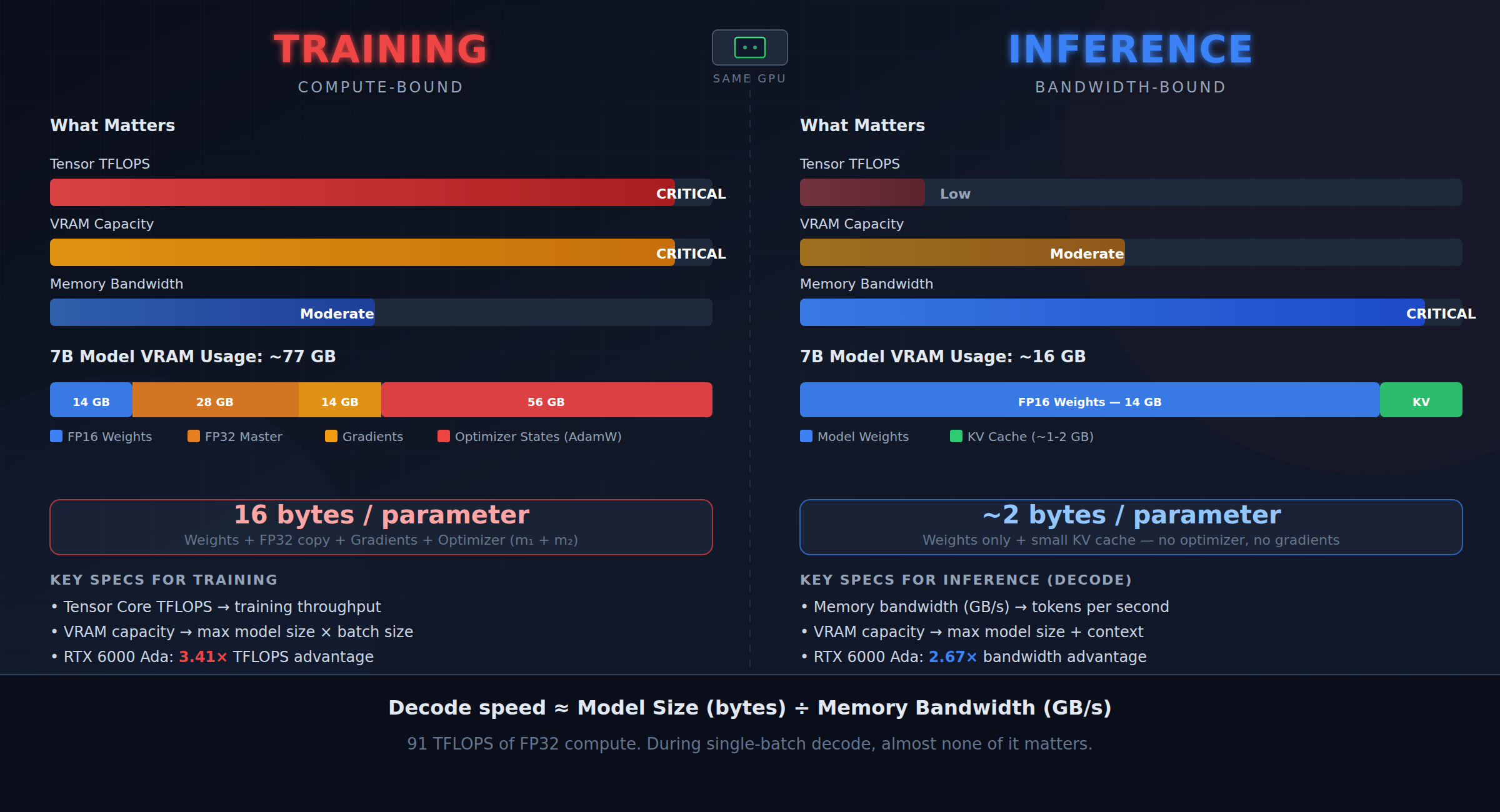
Your RTX 6000 Ada has 91 TFLOPS of FP32 compute. During inference, almost none of it matters.
Training and inference stress completely different parts of the GPU. Understanding which bottleneck dominates when is the difference between buying the right hardware and wasting thousands on specs that don’t matter for your workload.
This post fills the gap between two earlier deep-dives:
- Predict Peak VRAM Before Downloading a Model — exact VRAM estimation from Safetensors metadata
- Why GPUs Love Tensors: Understanding Tensor Cores — CUDA cores vs Tensor Cores explained
Here, we cover why the same GPU behaves completely differently during training vs inference, and how to choose the right GPU for each scenario — with the NVIDIA RTX 4000 Ada and RTX 6000 Ada as concrete examples.
1. Bottom Line First
- Training is compute-bound: Tensor Core TFLOPS and VRAM capacity are the gates.
- Inference decode is memory-bandwidth-bound: VRAM bandwidth is the gate; TFLOPS barely matter.
What Actually Matters
| GPU Spec | Training | Prefill (Prompt Processing) | Decode (Token Generation) |
|---|---|---|---|
| VRAM Capacity | Critical | Moderate | Moderate |
| Memory Bandwidth | Moderate | Moderate | Critical |
| Tensor Core TFLOPS | Critical | Critical | Low |
| CUDA Core TFLOPS | Low | Low | Low |
Should I Optimize for Compute or Bandwidth?
flowchart TD
    A[What is your workload?] --> B{Training or<br/>Inference?}
    B -->|Training| C{Full fine-tune<br/>or LoRA/QLoRA?}
    C -->|Full fine-tune| D["Compute-bound<br/>→ Maximize TFLOPS + VRAM"]
    C -->|LoRA/QLoRA| E["Compute-bound but<br/>lower VRAM needed"]
    B -->|Inference| F{Batch size?}
    F -->|"Single / small batch"| G["Bandwidth-bound<br/>→ Maximize GB/s"]
    F -->|"Large batch"| H{Prefill or<br/>Decode dominant?}
    H -->|"Long prompts"| I["Compute-bound<br/>→ TFLOPS matters"]
    H -->|"Long generation"| J["Bandwidth-bound<br/>→ Maximize GB/s"]

    style D fill:#e74c3c,color:#fff
    style E fill:#e67e22,color:#fff
    style G fill:#2980b9,color:#fff
    style I fill:#e74c3c,color:#fff
    style J fill:#2980b9,color:#fff
2. Where Does VRAM Go? Training vs Inference
The same 7B-parameter model can need ~77 GB during training or ~16 GB during inference. The difference comes down to what each phase needs to keep in memory.
Training VRAM Stack
Mixed-precision training with AdamW stores five copies of your model’s parameters, plus activations:
| Component | Bytes per Parameter | 7B Model |
|---|---|---|
| FP16 model weights | 2 | 14 GB |
| FP32 master copy | 4 | 28 GB |
| FP16 gradients | 2 | 14 GB |
| AdamW first moment (FP32) | 4 | 28 GB |
| AdamW second moment (FP32) | 4 | 28 GB |
| Subtotal (parameters) | 16 | ~112 GB |
| Activations (batch × seq × layers) | variable | varies |
The 16 bytes/param figure comes from HuggingFace’s Efficient Training guide and PyTorch AdamW documentation. With activation checkpointing and a modest batch size, a 7B model needs roughly 70–80 GB for full fine-tuning.
Inference VRAM Stack
Inference only needs the model weights and a KV cache:
| Component | Bytes per Parameter | 7B Model |
|---|---|---|
| FP16 model weights | 2 | 14 GB |
| KV cache (context-dependent) | — | ~1–2 GB |
| Current-layer activations | — | ~0.1 GB |
| Total | ~2 + KV | ~16 GB |
For exact KV cache formulas and the Safetensors metadata technique, see Predict Peak VRAM Before Downloading a Model.
VRAM Breakdown: 7B Model
graph LR
    subgraph "Training (~112 GB before activations)"
        T1["FP16 Weights<br/>14 GB"]
        T2["FP32 Master Copy<br/>28 GB"]
        T3["Gradients<br/>14 GB"]
        T4["AdamW States<br/>56 GB"]
    end

    subgraph "Inference (~16 GB)"
        I1["FP16 Weights<br/>14 GB"]
        I2["KV Cache<br/>~1–2 GB"]
    end

    style T4 fill:#e74c3c,color:#fff
    style T2 fill:#e67e22,color:#fff
    style T3 fill:#f39c12,color:#fff
    style T1 fill:#3498db,color:#fff
    style I1 fill:#3498db,color:#fff
    style I2 fill:#2ecc71,color:#fff
What Fits on Real Hardware?
| Scenario | VRAM Needed | RTX 4000 Ada (20 GB) | RTX 6000 Ada (48 GB) |
|---|---|---|---|
| 7B inference (FP16) | ~16 GB | Tight fit | Comfortable |
| 7B inference (INT4) | ~5 GB | Easy | Easy |
| 13B inference (FP16) | ~28 GB | No | Fits |
| 7B full fine-tune | ~77 GB | No | No (need multi-GPU) |
| 7B QLoRA fine-tune | ~10–18 GB | Possible | Comfortable |
| 13B QLoRA fine-tune | ~20–30 GB | No | Fits |
3. The Spec Sheet Trap: Why TFLOPS Don’t Predict Inference Speed
This is the most common mistake when choosing a GPU for inference: assuming more TFLOPS = faster token generation. It doesn’t, and the reason is the roofline model.
Arithmetic Intensity and the Roofline Model
Every operation has an arithmetic intensity: the ratio of compute (FLOPs) to data movement (bytes read from memory).
\[\text{Arithmetic Intensity} = \frac{\text{FLOPs}}{\text{Bytes Accessed}}\]The GPU has two ceilings:
- Compute ceiling: peak TFLOPS
- Bandwidth ceiling: peak GB/s
The roofline is the lower of the two. Operations with low arithmetic intensity hit the bandwidth ceiling — no matter how many TFLOPS you have.
graph TB
    subgraph "Roofline Model"
        direction LR
        A["Low Arithmetic Intensity<br/>(Decode: ~1 FLOP/byte)<br/>→ BANDWIDTH-BOUND"] --- B["Ridge Point<br/>(where ceilings meet)"] --- C["High Arithmetic Intensity<br/>(Prefill, Training: ~100+ FLOPs/byte)<br/>→ COMPUTE-BOUND"]
    end

    style A fill:#2980b9,color:#fff
    style C fill:#e74c3c,color:#fff
    style B fill:#95a5a6,color:#fff
Prefill vs Decode: Two Completely Different Workloads
Prefill processes all input tokens in parallel. It’s a large matrix multiplication:
\[\text{Attention}(Q, K, V) = \text{softmax}\left(\frac{QK^T}{\sqrt{d_k}}\right)V\]With thousands of tokens processed simultaneously, the arithmetic intensity is high. Prefill is compute-bound — more TFLOPS means faster prefill.
Decode generates one token at a time. Each token requires reading the entire model’s weights from VRAM, but performs only a tiny vector-matrix multiply. The arithmetic intensity is approximately:
\[\text{AI}_{\text{decode}} \approx \frac{2 \text{ FLOPs/param}}{2 \text{ bytes/param (FP16)}} = 1 \text{ FLOP/byte}\]This is far below the ridge point of any modern GPU. Decode is bandwidth-bound.
The Formula That Actually Predicts Inference Speed
For single-batch decode, the time per token is approximately:
\[t_{\text{token}} \approx \frac{\text{Model Size (bytes)}}{\text{Memory Bandwidth (bytes/s)}}\]This is the transformer inference arithmetic that matters. Let’s apply it:
7B model in FP16 (14 GB weights):
| GPU | Bandwidth | Predicted tok/s | TFLOPS (FP32) |
|---|---|---|---|
| RTX 4000 Ada | 360 GB/s | ~26 tok/s | 26.7 |
| RTX 6000 Ada | 960 GB/s | ~69 tok/s | 91.1 |
| Ratio (6000/4000) | 2.67× | ~2.65× | 3.41× |
The throughput ratio (~2.65×) tracks the bandwidth ratio (2.67×), NOT the TFLOPS ratio (3.41×). This is direct evidence that decode is bandwidth-bound.
These are theoretical upper bounds assuming perfect bandwidth utilization. Real-world numbers will be somewhat lower due to overhead, but the ratios hold. See NVIDIA’s LLM Inference Benchmarking guide for the canonical explanation of this effect.
4. RTX 4000 Ada vs RTX 6000 Ada: Head-to-Head
Both are professional Ada Lovelace GPUs, but they target different workloads. Here’s the full spec comparison:
Specifications
| Spec | RTX 4000 Ada | RTX 6000 Ada | Ratio (6000/4000) |
|---|---|---|---|
| CUDA Cores | 6,144 | 18,176 | 2.96× |
| Tensor Cores (4th gen) | 192 | 568 | 2.96× |
| FP32 TFLOPS | 26.7 | 91.1 | 3.41× |
| FP16 Tensor TFLOPS | 53.4 | 182.2 | 3.41× |
| FP8 Tensor TFLOPS | 106.8 | 364.4 | 3.41× |
| VRAM | 20 GB GDDR6 | 48 GB GDDR6 | 2.40× |
| Memory Bandwidth | 360 GB/s | 960 GB/s | 2.67× |
| Memory Bus | 160-bit | 384-bit | 2.40× |
| TDP | 130 W | 300 W | 2.31× |
| Form Factor | Single-slot | Dual-slot | — |
Specs sourced from NVIDIA RTX 4000 Ada and RTX 6000 Ada product pages, and the Ada Lovelace Architecture Whitepaper v1.1.
Where the Gap Matters Most
| What you’re doing | Key spec | Gap | Impact |
|---|---|---|---|
| Inference decode speed | Bandwidth | 2.67× | RTX 6000 generates tokens ~2.5× faster |
| Fitting large models | VRAM | 2.40× | 48 GB fits 13B FP16; 20 GB can’t |
| Training throughput | TFLOPS | 3.41× | RTX 6000 trains ~3× faster per GPU |
| Long-context inference | VRAM + BW | 2.4–2.7× | More KV cache capacity + faster access |
| Power/space constrained | TDP | 2.31× | RTX 4000 at 130 W, single-slot |
Key insight: The VRAM (2.4×) and bandwidth (2.67×) gaps matter more than the compute gap (3.41×) for most ML workloads. Training is the one scenario where the TFLOPS advantage fully applies.
5. Benchmarks: What the Numbers Actually Say
Inference Benchmarks (llama.cpp)
Puget Systems’ professional GPU benchmarks provide independent measurements using llama.cpp on professional GPUs:
| Metric | RTX 4000 Ada | RTX 6000 Ada | Ratio | Bottleneck |
|---|---|---|---|---|
| Prompt processing (tok/s) | ~1,500 | ~4,400 | ~2.9× | Compute-bound |
| Token generation (tok/s) | ~45 | ~105 | ~2.3× | Bandwidth-bound |
Note: Exact numbers vary by model, quantization, and llama.cpp version. The values above are representative of Q4_K_M quantized 7B models from the Puget Systems August 2024 dataset. Confidence: Medium-High — independent lab, but specific to llama.cpp backend.
The pattern is clear:
- Prompt processing ratio (~2.9×) is closer to the TFLOPS ratio (3.41×) — compute-bound
- Token generation ratio (~2.3×) is closer to the bandwidth ratio (2.67×) — bandwidth-bound
Training Throughput
Training benchmarks on professional Ada GPUs are less commonly published. Based on the compute ratio and memory subsystem differences:
| Scenario | Estimated RTX 6000 Ada Advantage | Confidence |
|---|---|---|
| Full fine-tuning (FP16 mixed precision) | ~2.5–3.0× | Medium |
| LoRA fine-tuning | ~2.5–3.0× | Medium |
| QLoRA fine-tuning (7B fits on both) | ~2.0–2.5× | Medium |
Training throughput estimates are derived from the TFLOPS and bandwidth ratios. Real-world numbers depend heavily on batch size, model architecture, and framework optimizations. For verified training benchmarks, check workstation vendors like BIZON and Puget Systems for updated results.
6. Quantization Changes Everything
Quantization doesn’t just save VRAM — it changes which GPU you need.
How Quantization Helps Inference
Quantized weights are smaller, which means:
- Less VRAM → larger models fit on smaller GPUs
- Less bandwidth consumed per token → faster decode (since decode is bandwidth-bound)
- Same TFLOPS → compute ceiling doesn’t change, but you hit it less often
For bandwidth-bound decode:
\[t_{\text{token}}^{\text{INT4}} \approx \frac{\text{Model Size}_{\text{INT4}}}{\text{Bandwidth}} \approx \frac{1}{4} \times t_{\text{token}}^{\text{FP16}}\]In practice, the speedup is closer to 1.5–2× over FP16 rather than the theoretical 4×, because quantization adds dequantization overhead and some layers remain in higher precision. See the NVIDIA quantization guide for details on the compute overhead of dequantization.
QLoRA for Training
QLoRA makes fine-tuning accessible on smaller GPUs by:
- Quantizing the base model to 4-bit (NF4)
- Training only small LoRA adapter weights in FP16/BF16
- Using paged optimizers to handle memory spikes
VRAM requirement drops from ~16 bytes/param (full fine-tune) to roughly 1.5–2.5 bytes/param for the frozen quantized base, plus a small overhead for the trainable adapters.
From the Modal VRAM fine-tuning guide: a 7B model can be QLoRA fine-tuned in ~10–18 GB depending on batch size and sequence length.
What Fits Where: Model Size × Precision × GPU
| Model | Precision | VRAM (est.) | RTX 4000 Ada (20 GB) | RTX 6000 Ada (48 GB) |
|---|---|---|---|---|
| 7B | FP16 | ~14 GB | Yes (tight) | Yes |
| 7B | INT8 | ~7 GB | Yes | Yes |
| 7B | INT4 | ~4 GB | Yes | Yes |
| 13B | FP16 | ~26 GB | No | Yes |
| 13B | INT8 | ~13 GB | Yes | Yes |
| 13B | INT4 | ~7 GB | Yes | Yes |
| 30B | FP16 | ~60 GB | No | No |
| 30B | INT4 | ~17 GB | Yes (tight) | Yes |
| 70B | FP16 | ~140 GB | No | No |
| 70B | INT4 | ~35 GB | No | Yes (tight) |
VRAM estimates are for weights only — add KV cache overhead for long contexts. Estimates include ~5% overhead for quantization scales. For exact per-model numbers, use the VRAM estimation script with safetensors metadata.
7. Decision Framework: Which GPU for Which Job?
flowchart TD
    START["What's your ML task?"] --> TASK{Training or<br/>Inference?}

    TASK -->|Training| FT{Full fine-tune<br/>or LoRA/QLoRA?}
    FT -->|Full fine-tune| FT_SIZE{"Model size?"}
    FT_SIZE -->|"≤3B"| FT_SMALL["RTX 4000 Ada may work<br/>(check 16×param rule)"]
    FT_SIZE -->|"7B+"| FT_LARGE["RTX 6000 Ada or multi-GPU<br/>(7B needs ~77 GB)"]
    FT -->|LoRA/QLoRA| QL_SIZE{"Model size?"}
    QL_SIZE -->|"≤7B"| QL_SMALL["RTX 4000 Ada works<br/>(10–18 GB for QLoRA)"]
    QL_SIZE -->|"13B+"| QL_LARGE["RTX 6000 Ada recommended<br/>(20–30 GB for QLoRA)"]

    TASK -->|Inference| INF_SIZE{"Model + precision<br/>fits in VRAM?"}
    INF_SIZE -->|"Fits in 20 GB"| INF_SMALL["RTX 4000 Ada is fine<br/>Bandwidth is the bottleneck<br/>Save money/power/space"]
    INF_SIZE -->|"Needs 21–48 GB"| INF_LARGE["RTX 6000 Ada required<br/>Also ~2.5× faster decode"]
    INF_SIZE -->|"Needs >48 GB"| INF_MULTI["Multi-GPU or cloud<br/>Consider quantization first"]

    style FT_LARGE fill:#e74c3c,color:#fff
    style QL_LARGE fill:#e67e22,color:#fff
    style QL_SMALL fill:#27ae60,color:#fff
    style FT_SMALL fill:#27ae60,color:#fff
    style INF_SMALL fill:#27ae60,color:#fff
    style INF_LARGE fill:#2980b9,color:#fff
    style INF_MULTI fill:#8e44ad,color:#fff
Summary: Task × GPU Recommendation
| Task | RTX 4000 Ada (20 GB) | RTX 6000 Ada (48 GB) |
|---|---|---|
| Inference: 7B FP16 | Works, ~26 tok/s | Faster, ~69 tok/s |
| Inference: 7B INT4 | Comfortable, ~40+ tok/s | Overkill unless batching |
| Inference: 13B FP16 | Won’t fit | Works, ~35 tok/s |
| Inference: 70B INT4 | Won’t fit | Tight fit, works |
| QLoRA fine-tune: 7B | Works (10–18 GB) | Comfortable, faster |
| QLoRA fine-tune: 13B | Borderline | Recommended |
| Full fine-tune: 7B | Won’t fit | Won’t fit (need multi-GPU) |
| Prototyping / dev | Great — low power, single-slot | More capability per node |
When the RTX 4000 Ada Is Enough
- Inference on quantized models up to ~13B (INT4) or ~7B (FP16)
- QLoRA fine-tuning of 7B models
- Development and prototyping where iteration speed matters more than throughput
- Power-constrained or space-constrained deployments (130W, single-slot)
- Multiple GPUs: two RTX 4000 Adas (40 GB total, 720 GB/s aggregate) can sometimes beat one RTX 6000 Ada, depending on the framework’s multi-GPU support
When You Need the RTX 6000 Ada
- Inference on models that don’t fit in 20 GB (13B FP16, 70B INT4)
- Maximum single-GPU decode throughput (2.67× bandwidth advantage)
- QLoRA fine-tuning of 13B+ models
- Long-context inference where KV cache grows large
- Serving multiple concurrent requests (batched inference needs more VRAM)
8. Key Takeaways
- Training is compute-bound — maximize Tensor Core TFLOPS and VRAM capacity. The RTX 6000 Ada’s 3.41× TFLOPS advantage fully applies here.
- Inference decode is bandwidth-bound — VRAM bandwidth (GB/s) predicts token generation speed, not TFLOPS. The RTX 6000 Ada is ~2.5× faster for decode, matching its bandwidth ratio.
- VRAM determines what fits, not how fast it runs. Training a 7B model needs ~16 bytes/param (~77 GB with activations); inference needs ~2 bytes/param (~16 GB).
- Quantization changes the equation — INT4 models need ~4× less VRAM and get ~1.5–2× faster decode. A 70B model in INT4 fits on a single RTX 6000 Ada.
- QLoRA makes training accessible — fine-tune a 7B model in 10–18 GB (RTX 4000 Ada territory) instead of 77+ GB.
- Don’t overspend on TFLOPS for inference — if your quantized model fits on an RTX 4000 Ada, the RTX 6000 Ada’s extra compute won’t help with single-batch decode. The bandwidth advantage is real but may not justify the price difference for your use case.
For exact VRAM predictions before downloading any model, see Predict Peak VRAM Before Downloading a Model. For a deeper understanding of how Tensor Cores actually work, see Why GPUs Love Tensors.
Need Help with Your AI Project?
Whether you’re building a new AI solution or scaling an existing one, I can help. Book a free consultation to discuss your project.